
Mississippi Court Records After Jail Arrest
After a jail arrest in Mississippi, the first public trace is often a county booking or jail docket. That booking is not the full criminal case. Mississippi research for this statewide build separates the local jail side from the court side because the two records answer different questions. The jail record answers who received the person, when the person was booked, the cause of imprisonment, and the authority for release or discharge. The court record answers what charge was filed, which court has the case, whether a warrant or bond order exists, and how the charge was resolved.
Mississippi Code Section 19-25-63 is the local custody anchor. It requires each sheriff to keep a jail docket with the authority for receiving a prisoner, the prisoner's name, date received, date of arrest and commitment, cause of imprisonment, and release or discharge authority. That docket helps explain custody after an arrest. It does not replace the case docket in Justice Court, municipal court, County Court, or Circuit Court. For custody and booking details, use Mississippi inmate records. For booking photos, use Mississippi jail rosters and mugshots.
The court path can take time. A jail roster may show an arrest charge before the prosecutor files a complaint, information, indictment, or amended charge. The wording can change as facts are reviewed. Treat the jail charge as a custody label and the court record as the live case file.
The statewide court access point is shown on the Mississippi Electronic Courts page, which is the central judiciary route for electronic filing and case access.
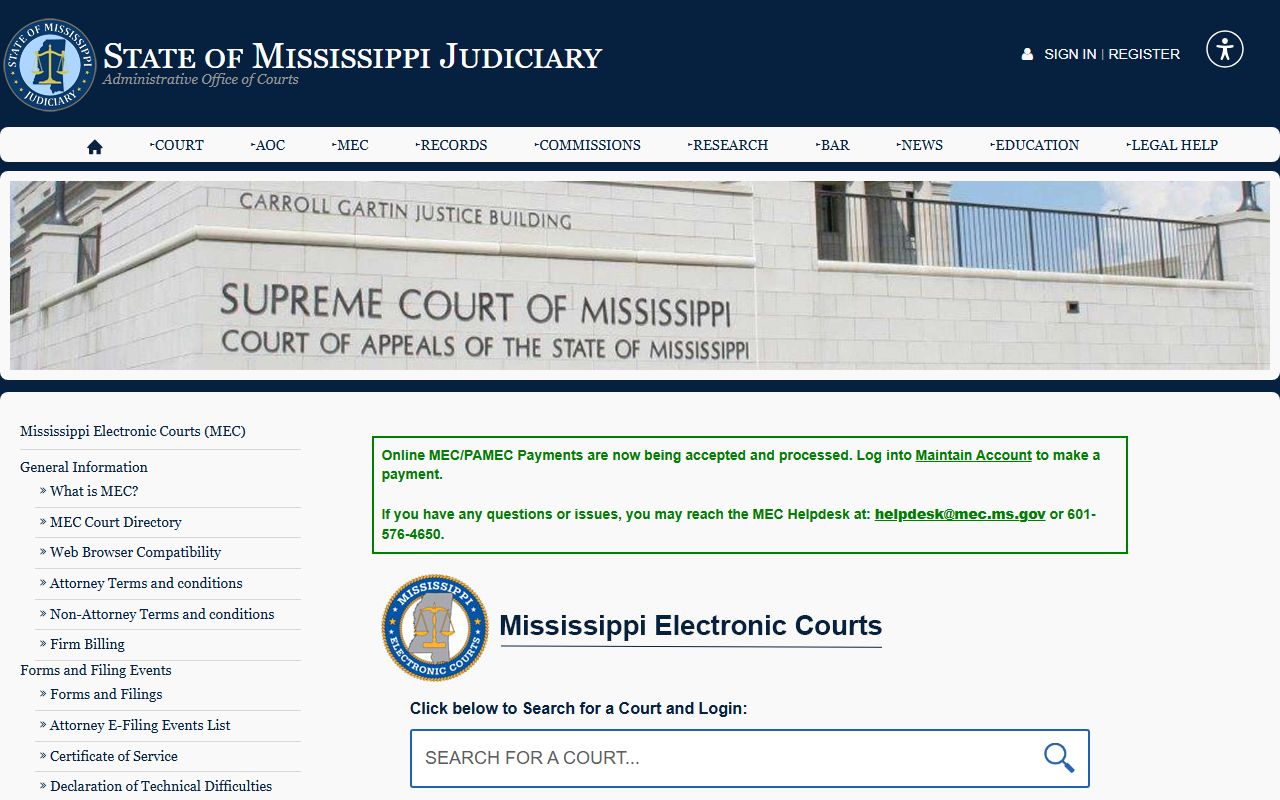
MEC is useful for court filings and dockets, while county jail custody still has to be checked through the sheriff or jail channel.
Mississippi Trial Court Path
Mississippi Electronic Courts, usually called MEC, is the statewide electronic filing and access system for courts that use it. The Mississippi Judiciary material says Chancery, Circuit, and County Courts use MEC to e-file trial-court records. Criminal matters after a jail arrest can also involve Justice Court or municipal court, and access can vary by county or city. That is why a statewide court records after arrest search should start with the county of arrest, then branch to the correct court.
For many felony cases, the court path runs from arrest and booking to first appearance, prosecutor review, grand jury action or other charging decision, and then Circuit Court proceedings. Misdemeanor matters may remain in Justice Court or municipal court, depending on the arresting agency and charge. County Court can matter in counties where that court exists and where the case type is assigned there. The statewide rule is simple: identify the arrest county, identify the court that received the charge, then search that court's docket or ask the clerk for the record procedure.
Use the County Directory when the arrest county is known but the local route is not. County pages can point to the sheriff, jail, and clerk route documented for that locality.
Find Court Records After Arrest
Mississippi court records after a jail arrest are found by matching the custody event to the court case. A name search alone can miss a case if the person used an alias, a middle name, or a different spelling at booking. A case number is stronger when available. A booking number is useful for the jail side, but it may not be the court case number. If the county jail has no online roster, the sheriff jail docket and the court clerk become more important.
- Start with the county where the jail arrest happened and check the county jail route for custody and booking details.
- Open the applicable court access route, including MEC where the court participates, or contact the local clerk for Justice Court or municipal court matters.
- Search by defendant name first, then use a case number when the jail, bond paper, clerk, or prosecutor has provided one.
- Read the charge list, status, bond orders, warrants, hearing settings, and disposition separately from the jail roster.
- If no case appears, check whether the arrest is too new, filed in a local court outside MEC, sealed, expunged, or still under prosecutor review.
MEC should not be used as a jail population tool. It is a court-record system. A person can be held in a county jail before a searchable court docket appears, and a person can have a court case after release from jail.
The Mississippi Ethics Commission public-records page explains the statewide public-records framework that applies when a written request is needed.
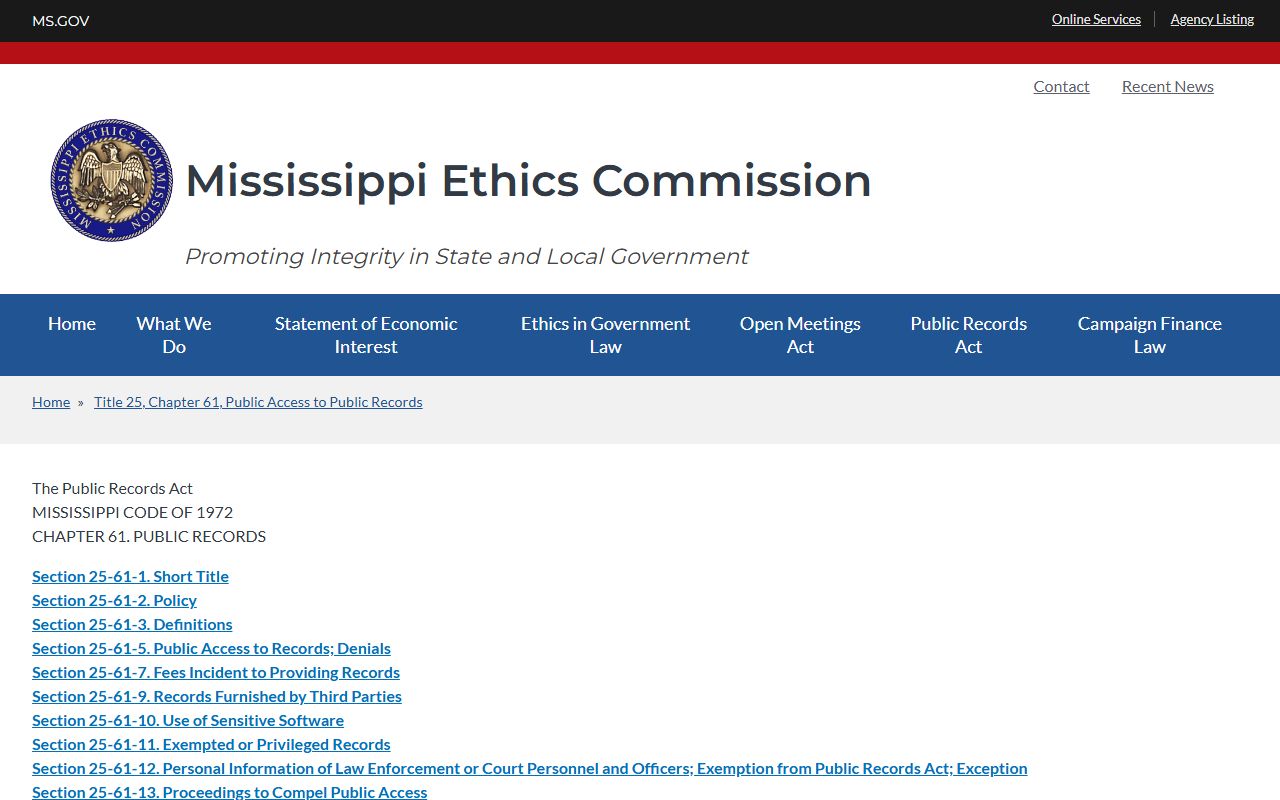
That law matters when court, jail, or agency records are not available through a public online index.
Charges After Jail Arrest
The words on a jail roster are not always the final court charge. Booking staff may enter an arresting charge, warrant label, or hold reason. The prosecutor can then file a complaint, proceed by information where allowed, seek an indictment, amend the charge, or decline part of the case. Mississippi court records after arrest should be read with that sequence in mind.
| Document | Who Uses It | What It Does |
|---|---|---|
| Complaint | Officer, prosecutor, or local court process | Starts or supports a criminal accusation after arrest, often early in the case. |
| Information | Prosecutor | States a formal charge without using the same grand-jury path as an indictment. |
| Indictment | Grand jury | Brings a felony charge into court after grand-jury action. |
A court record can show more than one charge source during the life of a case. A person may be booked on one label, indicted under another count, and convicted of a different offense after plea or trial. That is why charge status and disposition should be read together.
Mississippi Charge Status Records
Charge status is the part of the court record that tells whether an accusation is still active, changed, or resolved. It is not the same as custody status. A defendant may be out on bond with a pending court case, held in jail while a case is pending, moved to MDOC after sentence, or released after dismissal. The court docket and jail record can be true at the same time because they track different events.
| Status | Meaning in Court Records |
|---|---|
| Pending | The charge remains active and has not reached final disposition. |
| Amended or reduced | The filed charge changed from the first accusation or from a prior count. |
| Dismissed | The court record shows the charge was ended without a conviction on that count. |
| Nolle prosequi | The prosecution declined to proceed on that charge, subject to the record's specific terms. |
| Disposed | The court has entered a final result, such as plea, trial verdict, dismissal, or other order. |
Always check the latest docket entry. Older entries may remain visible even after a later order changes the charge or closes the case.
Bond Records After Arrest
Bond information often appears near the line between jail records and court records. A county jail may show bond status because bond controls release from custody. The court file may show the bond order, warrant, revocation order, or hearing where bond was set or changed. Specific bond schedules and practices vary by county and court, so the statewide approach is to confirm both the jail status and the court order.
| Bond or Hold | How to Read It |
|---|---|
| Cash bond | Money is posted according to the court or jail process before release. |
| Surety bond | A bonding company posts bond under local court and jail rules. |
| Personal recognizance | The court allows release on a promise to appear, subject to conditions. |
| No-bond hold | Release is blocked until a court order, warrant issue, detainer, or other authority changes. |
| Detainer | Another agency or jurisdiction has asked the jail to hold the person. |
A detainer is not a conviction. It is a hold request or custody flag from another authority. The source agency should be checked before assuming why the person cannot be released.
For custody-change awareness after a jail arrest, Mississippi VINELink is a notification route rather than a full court docket.

VINELink can help monitor participating custody changes, but filed charges and dispositions still need the court or clerk route.
Charges Versus Convictions
A Mississippi arrest and a Mississippi conviction are not the same event. Arrest means a person was taken into custody or accused through a law-enforcement process. A charge means an accusation has been filed or recorded in court. A conviction means the case ended with a guilty plea, guilty verdict, or other conviction entry. Court records after a jail arrest should be read with that distinction first.
| Issue | Charge | Conviction |
|---|---|---|
| Stage | Accusation after arrest or prosecutor review | Final result after plea, trial, or qualifying order |
| What It Proves | That a case or count was filed | That guilt was legally established for that count |
| Where It Appears | Jail roster, complaint, indictment, or docket | Disposition, sentencing order, and later custody records |
Use neutral language when reading public records. A pending charge is not a conviction, and a booking entry can remain online even when a court record later shows dismissal or a different disposition.
Sealed or Expunged Records
Some court records after an arrest may be restricted. The research file does not provide a Mississippi expungement eligibility chart, so no statewide promise should be made about who qualifies. The safer public-records rule is to treat restricted, sealed, juvenile, and expunged matters as court-specific. If the public index does not show a case, that can mean no filing, a local court route, timing delay, data-entry variation, sealed access, juvenile handling, or expungement.
| Record State | Public Meaning | Best Route |
|---|---|---|
| Public | The case or docket entry is open through the court or clerk process. | Search MEC where applicable or contact the clerk. |
| Sealed | Access is limited by court order or law. | Ask the court clerk about access rules, not the jail. |
| Expunged | The record has been cleared under a court process. | Use the court that entered the expungement order. |
Public Records Timing
Mississippi's Public Records Act supplies the general timing rule when a written request is needed. Section 25-61-5 says a public body may adopt procedures for access and copying. If it has not adopted procedures, access should be provided within one working day after a written request. Procedures may not allow production or denial later than seven working days from receipt. If a record has exempt material, the agency must redact the exempt parts and produce nonexempt parts.
That rule does not make every court record appear online. It does help frame written requests to a sheriff, jail, clerk, or state agency. For MDOC records after sentence, use the MDOC public-records process. For court filings, use MEC where applicable and the clerk where the case is filed.
Note: A no-result search in MEC does not prove there was no jail arrest or local court filing.
When a Mississippi arrest later becomes state custody, the MDOC inmate-search page becomes the better place to confirm prison placement.
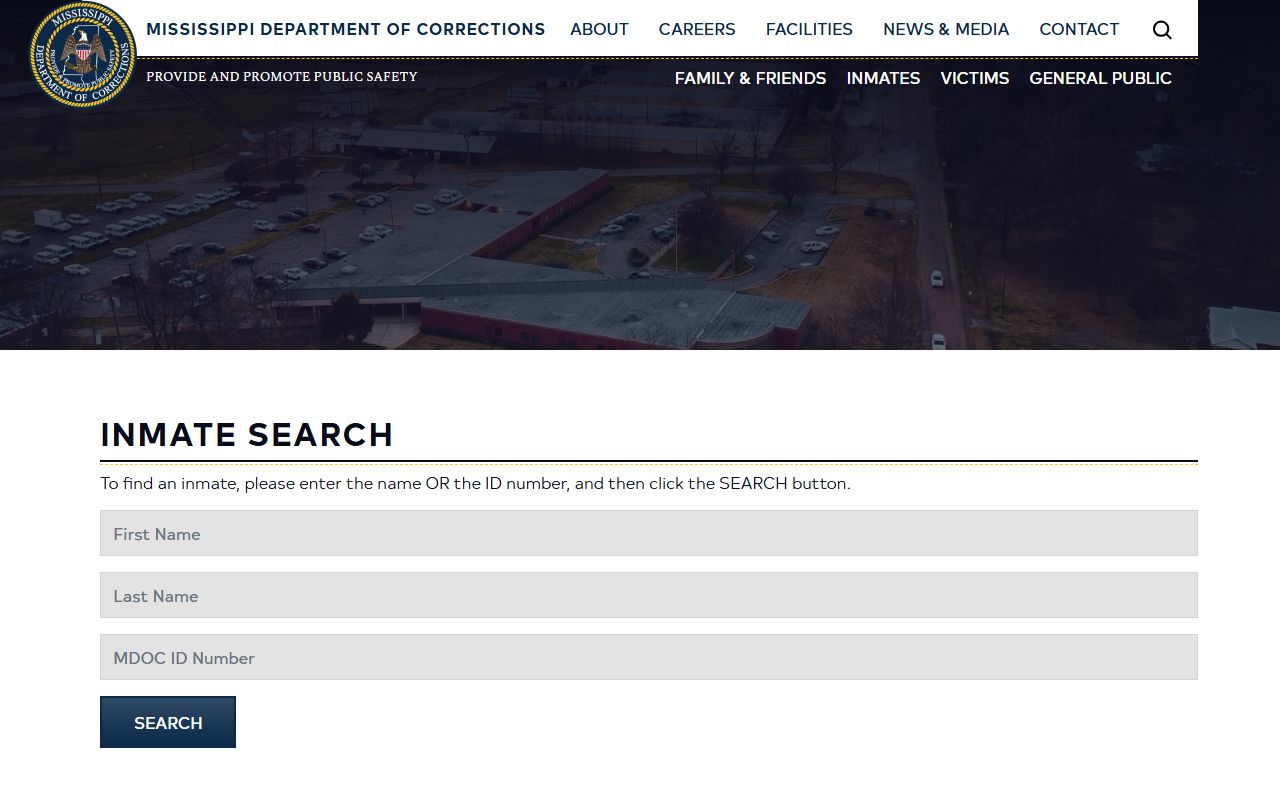
MDOC search is for state custody, not same-day county booking, so it should be paired with the court and jail records for the full path.
Restricted Arrest Court Records
Several record types require extra care. Juvenile matters, sealed proceedings, expunged cases, active investigations, and records with exempt personal information may not display the same way as an ordinary adult criminal docket. Mississippi public-records rules allow redaction of exempt material while producing nonexempt parts. That means a clerk or agency may provide part of a record, deny a restricted portion, or direct the requester to a court order process.
Federal and immigration custody are separate from Mississippi state and county courts. A person arrested on a federal case may later appear in the Federal Bureau of Prisons locator, and an immigration detainee may require ICE ODLS rather than MEC or MDOC. Court records after a jail arrest should be matched to the authority that filed the case.
Mississippi Arrest Record Path
The cleanest statewide path is arrest, booking, first appearance, filed charge, court docket, disposition, and then release, supervision, jail sentence, state prison, federal prison, or immigration custody depending on the case. Each step can create a different record. County jail rosters and sheriff jail dockets explain custody. MEC and local clerks explain court filings. MDOC explains sentenced state custody. BOP and ICE explain federal or immigration custody.
For Mississippi court records after a jail arrest, avoid relying on one search box. Start with the arrest county, then move to the court that took the charge. If the case ended in a state sentence, continue to MDOC. If the person is still locally held, return to the county jail record. That sequence keeps booking labels, filed charges, convictions, and custody status in the right lane.